"". UA-20896369
Showing posts with label War dogs. Show all posts

Tuesday, October 28, 2014

The Godfather of Military Dogs

Col. Richardson and Red Cross Dogs. Photo courtesy of Foreign Policy magazine.

We never thought we'd read an article in Foreign Policy magazine, let alone tout it on our pet blog, but we stumbled across (as one is want to do on the Internet), this fascinating article about Lt. Col. Edwin Hautenville Richardson, who pioneered and championed the use of dogs in the military during World War I.  Richardson was a British soldier who petitioned his government to allow specially trained dogs in the military—primarily to deliver messages across enemy lines. According to this article, "When Britain declared war in August 1914, it had virtually no dogs on the battlefield."

Col. Richardson led the charge to change that statistic, and one hundred years later, the impact of his passion and training methods lives on. "...Richardson's compassionate treatment of his dogs, as well as his practice of reward-based training—which reinforced good behavior and success with joyful attention and a treat or toy—are the models for dog handling today."

We hope you enjoy this bit of canine history, and perhaps to cheer the spirit of Col. Richardson, give your faithful companion a little job to do...and don't forget the joyful praise or small treat.

Monday, May 27, 2013

Remembering The Humans And Dogs Of War

Ryan McCourt, saluting the gravesite of his dad's mine detection dog, Mina, recently buried at the Michigan War Dog Memorial in South Lyon, Michigan. Photo courtesy of Elizabeth Conley/The Detroit News.

We guess that we're "preachin' to the choir", but we hope that as each of you remember our humans currently serving in the military and the veterans that came before them, you also give a salute to those amazing war dogs who have given their lives for our country, and prevented many additional human casualties.

This article published today in the Detroit News had us crying into our coffee this morning. It turns out that the Michigan War Dog Memorial and cemetery in South Lyon, Michigan, are one of only two places in the country that serve as the final resting spot for deceased military dogs. Sgt. Mina, a black Labrador, was a mine detection specialist who served two tours in Bosnia and nine in Afghanistan. She was adopted by Army Sgt. Corey McCourt when she retired from the military at age 12, and died of a lung ailment a year later.

It's interesting to note that there are proper burial procedures for canine military: Courtesy of the Michigan War Dog Memorial and in consultation with the United States War Dog Association, Mina's remains were given "a slow hand salute , his biography was read, and a chaplain spoke...a folded American flag was presented and taps was played. Then four German shepherds offered a canine salute to their fallen comrade: They howled and then stomped on command."

And we're proud to say that an Ohio-based organization, Support Military Working Dogs, founded in 2008, "raises money and purchases equipment for military dogs and their handlers." One of their board members, Tracy Spader, adopts many of the retired military canines-she just took home Jig, a six-year-old black Lab who earned the honorary rank of marine sergeant, sniffing out explosives. Unfortunately, Jig has oral melanoma. "I take the guys who need the most love," said Spader.

A hearty thank you, this Memorial Day, to both human and canine who have served or are currently serving in the United States military. Parental Unit would like to give a special mention to both her grandfather, Guiseppe DiMartino, who as a recent immigrant from Italy, fought in W.W. I, and to his first born child, Louis DeMartin, Parental Unit's late father, who fought in W.W. II.


Monday, May 28, 2012

Memorial Day Thanks To Our Two And Four-Legged Heroes

As we pause amidst our Memorial Day festivities, to honor both the humans and canines who lost their lives defending us around the globe, we hope that you will give special consideration to our four-legged heroes. These faithful dogs did not enlist, but were rather enlisted by us to help serve the military wherever and whenever we deemed it necessary. And we can only imagine that they did whatever was asked of them, without complaint.


Here's a list, courtesy of Dog Fancy's online presence, Dog Channel.com, of the names of famous military dogs and the important jobs they performed during their service to our country. We are particularly partial to "Chips", a mixed breed dog who was donated to the U.S. military by his family and became "the most decorated war dog of W.W. II."

We hope you enjoy reading about these canine heroes as much as we did, and that you enjoy your holiday.

Monday, September 05, 2011

Working Dogs Deserve Labor Day Salute, Too!

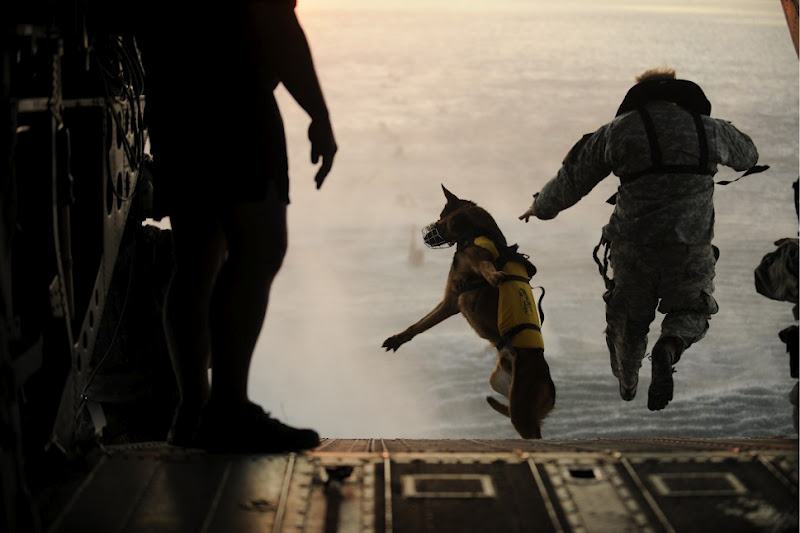
From the military dog, Cairo, that helped storm Bin Laden's compound to the countless number of service dogs that help the disabled with their everyday tasks, we think today's celebrations should include a recognition and a hearty "thank you" to all of our country's working canines.
Photo courtesy of Foreign Policy Magazine


Speaking of working canines, The Orlando Sentinel published this list from the American Kennel Club that describes five different ways dogs use their incredible sense of smell to help humans:

Bed bug sniffing:  Bed bugs became a major problem for businesses and homeowners during the past few years, so a new employee entered the work force – the dog. Professional groups have established standards in bed bug-detector dog training, testing and certification. Breeds commonly used to hunt bed bugs include the beagle and Labrador retriever.
Search and rescue:  From missing persons cases to natural disasters, dogs have been an integral part in finding people who are in dire situations. Training begins in puppy hood, and when completed the dogs are tested and certified by search and rescue organizations. Breeds most commonly recruited include the bloodhound and German shepherd.
Explosives detection:  Many recent examples have been in the news, especially in military and law-enforcement areas. The dogs go through an intense training course to learn how to find and identify a wide variety of explosives and to alert their handlers. Breeds that excel in this kind of work include the German shepherd and Vizsla.
Cancer detection:  Scientists have been able to train Labrador retrievers to sniff out cancer in patients’ breath. In one case, the Lab correctly diagnosed the disease 98 percent of the time.
Allergy alert dogs:  Peanut allergies can be life-threatening. Dogs are trained to detect the peanut allergen and its residue at schools, social events and everyday activities and alert their owner. Breeds that most commonly work as allergy alert dogs include the poodle and Portuguese water dog.
  By the way, does preparing for football season count as "work"?


Tuesday, May 24, 2011

Cairo Helps Spur War Dog Adoptions


By now, we've all heard of "Cairo" the brave military dog that was with the Navy SEAL Commandos that raided Osama bin Laden's compound. Although his breed still has not been divulged, we learned from a piece in the Huffington Post published just this afternoon, that part of his job was to track anyone who tried to escape from bin Laden's compound and to alert the commandos to anyone approaching that area.

 But it seems that Cairo has served another, perhaps unintended purpose: he's bumped the applications for adopting retired military dogs sky high. According to this post, about 300 retired military dogs are put up for adoption each year, but "officials say that they've received more than 400 adoption applications in the three weeks since the May 2 raid." We say, "Kudos to Cairo!"

 Another important point raised in this post is the hefty cost to adopt a retired military dog- the adoptive owners usually must pay to transport the dog from overseas on commercial flights, costing between $1000-$2000. According to military personnel interviewed for this article, when retired dogs are adopted, they no longer belong to the military, "so it would be fraud, waste and abuse for the {Department of Defense] to transport that pet." And get this: "officially, military dogs are considered equipment, and retired dogs are excess or surplus equipment". (We can't help but wonder if the military doesn't routinely pay to transport surplus equipment...). Thankfully, there's a move underway to reclassify the dogs as canine veterans, which will take an act of Congress. We will investigate how we can get involved with this movement and let you know. Both Parental Unit and I think a write-in campaign to our congress persons is in order.

Read the full and fascinating article here: www.huffingtonpost.com/huff-wires/20110524/us-fea-pets-war-dogs/ and let us know what you think. Equipment or veterans?

Friday, March 25, 2011

War Dogs

We wanted to share this moving video posted on The New York Times website with you. It shows and discusses how many of our soldiers have bonded with stray dogs in Afghanistan. Beautiful in a strange and unfortunate way, we think...

View it here: www.nytimes.com/interactive/world/battalion.html#/NYT/Shorts/35
Related Posts Plugin for WordPress, Blogger...